
If you’ve tried antidepressants and still don’t feel like yourself — or you’ve watched someone you love cycle through medication after medication with little to show for it — you’re not alone, and you’re not out of options.
In my 30 years of practicing psychiatry, one of the most important shifts I’ve witnessed is the emergence of interventional treatments that work through entirely different mechanisms than traditional antidepressants. For patients with treatment-resistant depression, these aren’t last resorts. For many, they’re the beginning of a real recovery.
Three treatments come up most often in these conversations: Spravato (esketamine), TMS (Transcranial Magnetic Stimulation), and ketamine therapy. All three can be highly effective. None of them is right for everyone. And the differences between them matter more than most people realize.
This post is my honest, clinical breakdown — not a sales pitch for any one option.
“At Thrive Brain and Mind, we offer all three. That means our only agenda is finding what’s right for you.”
First: What Is Treatment-Resistant Depression?
Before we compare treatments, it helps to understand who these treatments are designed for.
Treatment-resistant depression (TRD) is typically defined as depression that hasn’t responded adequately to at least two antidepressant medications, taken at the right dose for the right amount of time. It affects roughly one in three people with major depression — which means if standard antidepressants haven’t worked for you, you’re in large company.
TRD doesn’t mean your depression is more severe than someone else’s. It means your brain’s chemistry or circuitry may respond better to a different approach. That’s exactly what Spravato, TMS, and ketamine target.
Spravato (Esketamine): FDA-Approved, Fast-Acting, Insurance-Covered
What it is
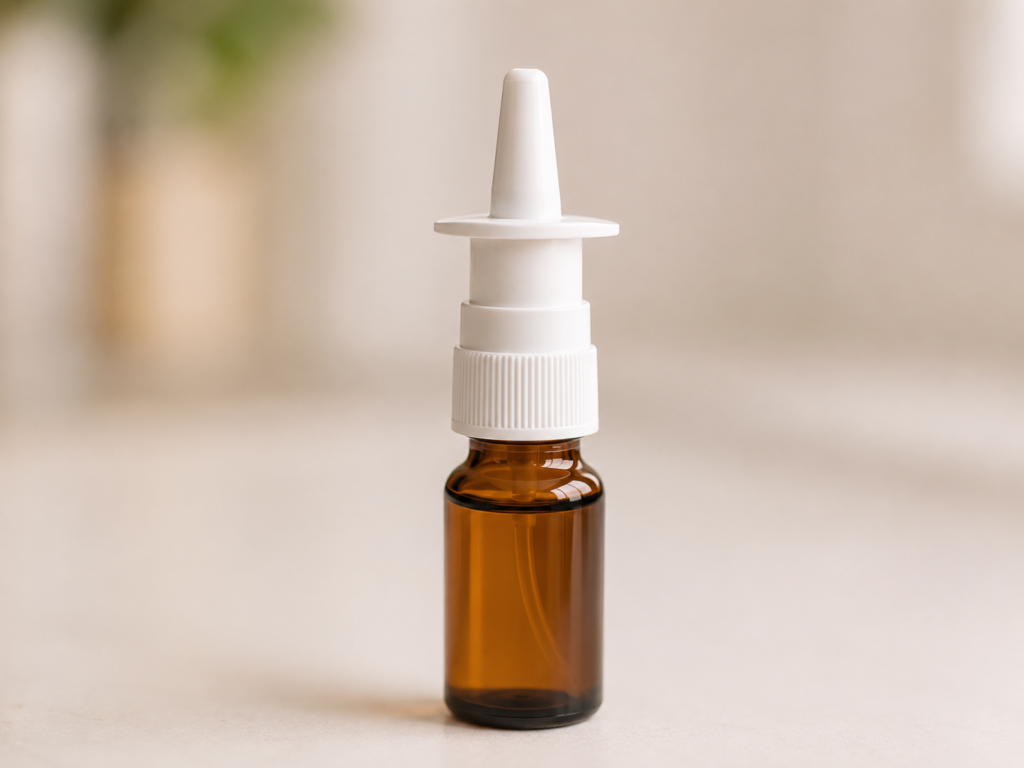
Spravato is an FDA-approved nasal spray containing esketamine — the S-enantiomer of ketamine. It’s the first and only FDA-approved ketamine-based treatment for treatment-resistant depression in adults. It’s also approved for major depressive disorder with acute suicidal ideation.
How it works
Unlike SSRIs and SNRIs, which target serotonin and norepinephrine, Spravato works on the brain’s glutamate system — specifically NMDA receptors. This different mechanism is precisely why it works for patients who’ve failed traditional antidepressants. Some patients notice meaningful improvement within the first one to two weeks of treatment.
What the process looks like
Spravato is self-administered as a nasal spray in our Powell clinic, under clinical supervision. After each session, you remain in our monitoring area for approximately two hours. You cannot drive on the day of treatment. Sessions are twice weekly during the initial four-week induction phase, then taper to once weekly and eventually once every one to two weeks for maintenance.
Who it tends to work best for
- Adults with treatment-resistant depression who meet clinical criteria
- Patients who want an FDA-approved, insurance-covered option
- Those who need relatively rapid relief — not waiting 4–6 weeks
- Patients with major depressive disorder and active suicidal ideation (the only FDA-approved fast-acting option for this indication)
What to know going in
Spravato requires regular clinic visits — this is not a take-home medication. Side effects like temporary dissociation, dizziness, and nausea are common during or shortly after administration and resolve before you leave. Whether it’s paired with an oral antidepressant depends on your diagnosis: as of the 2025 update, treatment-resistant depression can be treated with Spravato on its own or alongside an oral antidepressant, while major depressive disorder with acute suicidal ideation is still treated with Spravato together with an oral antidepressant. Because it requires ongoing maintenance sessions, it works best for patients who can commit to the cadence.
“Spravato changed the conversation for patients who’d been told they’d just have to ‘keep trying medications.’ There’s now an FDA-approved, insurance-covered alternative — and it works through a completely different pathway.”
TMS (Transcranial Magnetic Stimulation): No Medication, No Sedation, Durable Results
What it is
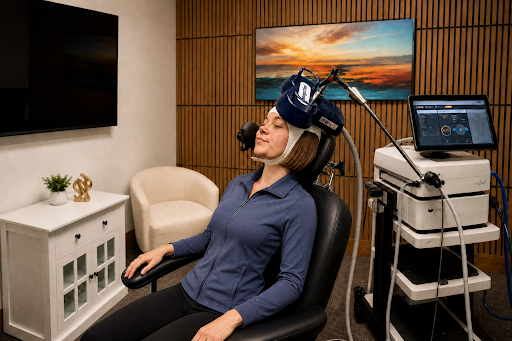
TMS is an FDA-cleared, non-invasive treatment that uses focused magnetic pulses to stimulate specific areas of the brain involved in mood regulation — primarily the prefrontal cortex, which is often underactive in depression. It involves no medication, no needles, no anesthesia, and no recovery time.
How it works
Each TMS session involves a device placed against the scalp that delivers brief magnetic pulses to the target brain region. Over a course of treatment, this repeated stimulation strengthens neural circuits and gradually “resets” depressive brain activity patterns. Think of it as physical therapy for the brain — it’s not dramatic, but the cumulative effect can be profound.
What the process looks like
TMS is typically administered five days per week for four to six weeks. Each session takes 20–40 minutes. You can drive yourself to and from appointments, return to work or normal activities immediately, and go about your day without any impairment. There’s no dissociation, no sedation, and no required monitoring period.
Who it tends to work best for
- Adults with treatment-resistant depression who want a medication-free option
- Patients who can’t tolerate medication side effects or prefer not to add another drug
- Those looking for more durable long-term results over rapid short-term relief
- Patients for whom Spravato isn’t appropriate due to medical history or preference
What to know going in
TMS takes longer to show results than Spravato or ketamine — most patients notice significant improvement around weeks four to six. The upside is durability: research shows that TMS benefits can last months to years with light maintenance, compared to the more frequent ongoing sessions often required with ketamine-based treatments. TMS is generally avoided in patients with a history of seizures or with certain metal implants near the skull.
“TMS is the tortoise in this race. It’s slower to start working, but in my experience, the results tend to stick longer — which matters enormously for quality of life.”
Ketamine Therapy: Fastest Relief, Off-Label, Typically Self-Pay
What it is
Ketamine therapy uses racemic ketamine — a compound with decades of clinical history as an anesthetic — administered off-label for treatment-resistant depression, bipolar depression, and PTSD. “Off-label” means it’s not FDA-approved for these indications, but it is a legal and medically accepted practice under physician supervision.
How it works
Like Spravato, ketamine targets NMDA receptors and the glutamate system. The mechanism of action is similar — both work faster than traditional antidepressants and through a different biological pathway. Some patients describe noticing a shift in mood within hours of their first session.
Who it tends to work best for
- Patients who need the fastest possible relief and can manage self-pay costs
- Those who haven’t responded to Spravato or want an alternative to the nasal spray format
- Patients with bipolar depression or PTSD who are appropriate candidates (with proper off-label disclosure and clinical evaluation)
- Those who are waiting for insurance authorization for TMS or Spravato and need interim relief
Important disclosures
Ketamine for depression is off-label — meaning it does not have FDA approval for this use. This matters for informed consent and insurance: ketamine is typically not covered by insurance for psychiatric indications and is usually a self-pay expense. We discuss this transparently with every patient before recommending this path. We do not recommend ketamine for patients with active psychosis, uncontrolled hypertension, a history of substance misuse, or certain cardiovascular conditions.
Side-by-Side Comparison
| Spravato (Esketamine) | TMS | Ketamine | |
| FDA Status | FDA-approved (REMS certified) | FDA-cleared for depression | Off-label (not FDA-approved for depression) |
| How It Works | Nasal spray esketamine; targets NMDA/glutamate receptors | Magnetic pulses stimulate underactive brain circuits | Similar NMDA mechanism; typically given differently than Spravato |
| Speed of Relief | Hours to days for some patients | 4–6 weeks (gradual) | Hours to days for some patients |
| Durability | Requires ongoing maintenance sessions | More durable; some patients stay well months to years | Requires ongoing maintenance sessions |
| Insurance | Usually covered when criteria are met | Usually covered when criteria are met | Typically self-pay |
| In-Clinic Time | ~2 hours per session; cannot drive same day | ~30–40 min; drive yourself; no recovery time | Session length varies; cannot drive same day |
| Best For | TRD with need for rapid relief; insurance coverage preferred | TRD; prefers no medication; wants durable results | TRD; rapid relief needed; comfortable with off-label use |
| Not Ideal For | Certain cardiovascular conditions; active psychosis | History of seizures; certain metal implants near skull | Active psychosis; substance misuse history; uncontrolled hypertension |
So — Which One Is Right for You?
Honestly? There’s no universal answer. In my practice, I’ve seen patients who didn’t respond to TMS do beautifully on Spravato. I’ve seen patients fail multiple ketamine sessions and achieve remission with TMS. What I tell every patient is this: all three are legitimate, evidence-backed options — and an experienced clinician who offers all three is your best guide.
Here’s a simplified framework we use at Thrive Brain and Mind:
- If you need relatively rapid relief and want FDA-approved, insurance-covered treatment: Spravato is usually the first conversation.
- If you want to avoid medication entirely and can commit to a 4–6 week treatment course: TMS is often the right fit.
- If you need the fastest possible relief and are comfortable with off-label, self-pay treatment: Ketamine may be appropriate.
- If you’re unsure: That’s exactly what a consultation is for. A thorough evaluation takes your full history into account — prior medications, current symptoms, medical history, lifestyle, and goals — and produces a recommendation tailored to you, not to a protocol.
“These aren’t competing treatments. They’re different tools. The right clinician helps you understand which tool fits your situation.”
Spravato, TMS, and Ketamine in Powell and Columbus, Ohio
Thrive Brain and Mind offers all three interventional treatments at our Powell, Ohio clinic, serving patients across the greater Columbus area — including Dublin, Westerville, Lewis Center, Delaware, Upper Arlington, and beyond.
Our practice is led by Dr. John J. Aziz, a quadruple board-certified psychiatrist with over 30 years of clinical experience, including extensive work in interventional psychiatry. We are a REMS-certified Spravato treatment center, which means we meet the FDA’s strict requirements for administering esketamine safely.
If you or someone you care about has been living with depression that hasn’t responded to medications, we’d like to be part of the conversation. A consultation with Dr. John J. Aziz starts with a thorough evaluation — not a sales pitch — and ends with a clear, honest plan.
→ Schedule a consultation at Thrive Brain and Mind, Powell, Ohio
Frequently Asked Questions
Is Spravato the same as ketamine?
No. Spravato contains esketamine, the S-enantiomer of ketamine, delivered as a nasal spray in a REMS-certified clinical setting. It is FDA-approved for treatment-resistant depression. Ketamine (racemic ketamine) is used off-label and is typically administered differently. They share a similar mechanism of action but differ significantly in FDA status, insurance coverage, and administration.
Does insurance cover TMS or Spravato?
Yes — both TMS and Spravato are typically covered by commercial insurance plans and Medicare when clinical criteria are met. This usually includes documented failure of at least two antidepressant medications. Ketamine therapy for depression is generally not covered by insurance and is typically self-pay. Our team verifies your specific benefits before you begin treatment.
Can I do TMS and Spravato at the same time?
In some cases, yes. There is growing clinical interest in combining TMS and ketamine-based treatments, with TMS providing longer-lasting structural change and Spravato or ketamine providing faster short-term relief. Whether combination therapy is appropriate depends on your specific situation and will be evaluated during your consultation.
How do I know if I qualify for Spravato?
The primary criteria are: you are an adult with treatment-resistant depression (not responded to at least two antidepressants) or major depressive disorder with active suicidal ideation, and you do not have any absolute contraindications (certain cardiovascular or cerebrovascular conditions). A full psychiatric evaluation at Thrive Brain and Mind will determine whether Spravato is appropriate for you.
For treatment-resistant depression, Spravato may be used with or without an oral antidepressant; for MDD with acute suicidal ideation, it’s used together with one.
Where can I get Spravato treatment near Columbus, Ohio?
Thrive Brain and Mind in Powell, Ohio is a REMS-certified Spravato treatment center serving patients throughout the greater Columbus area. Call our office to schedule an evaluation with Dr. John J. Aziz.